
A rare interstellar visitor named 3I/ATLAS is currently passing through our solar system, drawing global attention from scientists and space enthusiasts alike. Unlike typical comets that originate within our own solar system, 3I/ATLAS comes from outside, making it only the third confirmed interstellar object ever detected by astronomers.
The object is moving at an extremely high speed on a hyperbolic path, which clearly shows that it is not gravitationally bound to the Sun. In simple terms, 3I/ATLAS is just passing through it came from deep space and will continue its journey back into interstellar darkness after its flyby.
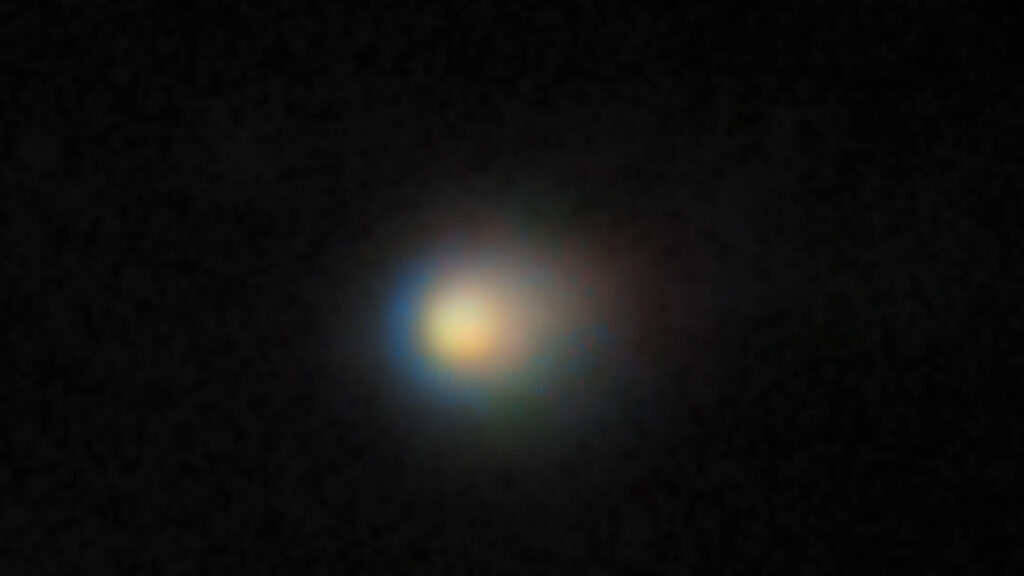
As 3I/ATLAS makes its closest approach to Earth in mid-December 2025, many people have naturally raised concerns about a possible collision. However, scientists have firmly ruled out any danger. Even at its nearest point, the object remains hundreds of millions of kilometers away, far beyond the Moon’s orbit and even well outside the distance between Earth and the Sun. There is zero chance of it hitting our planet.
NASA and other space agencies are closely tracking the object, not because it’s dangerous, but because it offers a rare scientific opportunity. Studying interstellar objects like 3I/ATLAS helps researchers understand what materials exist around other stars and how planetary systems beyond ours may form.
While it won’t be visible to the naked eye, advanced telescopes may capture faint views of this mysterious traveler as it glides past Earth. For astronomers, events like this are once-in-a-generation moments not a threat, but a window into the wider universe.